The Real Cost of Idling Bucket Trucks
The Real Cost of Idling Bucket Trucks (And Why It's Higher Than Most Fleets Realize)
|
The short answer: A utility bucket truck running its diesel engine at idle to power the bucket lift burns about 1.5 gallons of diesel per hour. At six hours of daily PTO use, that's 2,340 gallons of diesel and 5,253 pounds of CO2 per truck, per year, before counting added maintenance, accelerated engine wear, idle-time fines, and lost resale value. The total annual cost per truck commonly lands between $11,000 and $18,000. |
Most fleet managers know idling is expensive. Fewer have put a number on it that holds up in a budget meeting. The reason is that idling cost isn't a single line item on a fuel report. It hides across five different cost centers, which makes it easy to underestimate and easy to ignore.
This is what the full cost actually looks like, line by line, for a typical utility or municipal bucket truck operating in 2026.
What "idling" actually means on a work truck
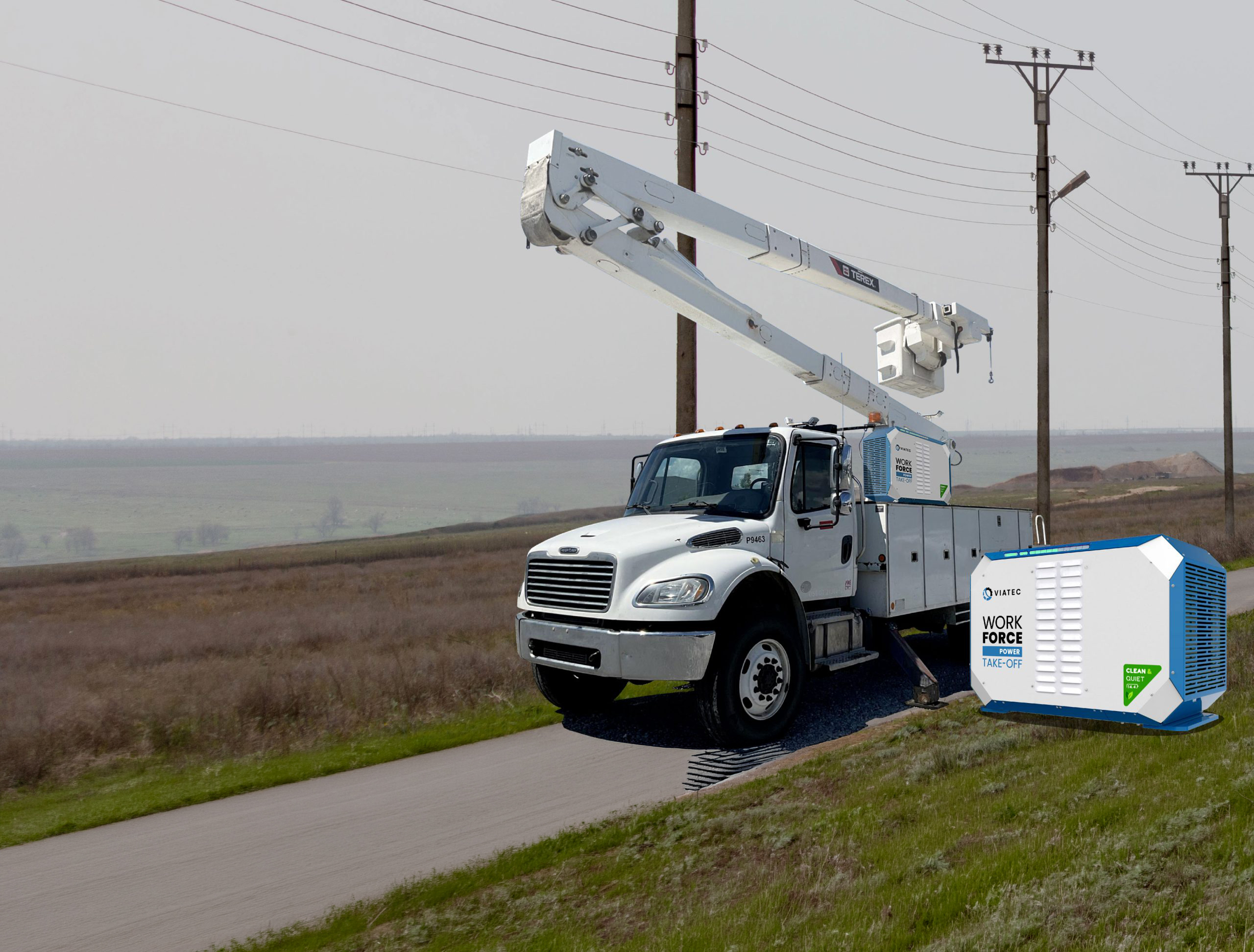
When a bucket truck pulls up to a pole or transformer, the operator engages the power take-off (PTO), and the truck's diesel engine continues running for the entire duration of the lift work. That can be 30 minutes for a quick fix. It can be six to eight hours for a major repair, vegetation management job, or storm restoration shift.
The engine is doing one job during that time: driving the PTO so the hydraulic pump can run the bucket. It's not moving the truck. It's not powering anything else. It is, by every operational definition, idling.
The five hidden cost layers
1. Direct fuel burn
A 33,000 to 37,000 GVWR diesel bucket truck consumes 0.8 to 1.5 gallons of diesel per hour at PTO idle, depending on engine size and load. Most fleets use 1.0 to 1.2 gph as a working estimate, though heavier hydraulic loads push higher.
At 1.0 gph, six hours of PTO use per day, 250 working days per year, that's 1,500 gallons of diesel per truck, per year. At the early-2026 national fleet diesel average of approximately $3.95/gallon, that's $5,925 in direct fuel cost per truck, per year. Push the duty cycle to 1.5 gph and eight hours of daily PTO use, and the fuel cost alone exceeds $11,800 per truck.
2. Maintenance acceleration
Engine hours accumulated at idle wear an engine roughly as fast as engine hours accumulated in service, but generate zero productive miles. Many fleets are surprised to find that 30 to 50% of their total engine hours come from idle operation, not driving.
This shows up as:
- More frequent oil and filter changes
- Premature DPF (diesel particulate filter) clogging from low-temperature exhaust
- DEF system issues from sustained low-load operation
- Earlier turbocharger wear
- Reduced injector and EGR system life
- Limits in-bucket-to-ground crew communication, slowing work
- Generates customer and resident complaints, especially on early-morning or night shifts
- Increases crew fatigue on long shifts
- Forces crews into shorter PTO sessions in noise-sensitive zones
Industry data suggests idle hours add 15 to 25% to total annual maintenance costs on heavy-duty diesel work trucks. For a truck with a baseline $4,000 to $6,000 annual maintenance budget, that's an additional $600 to $1,500 in idle-attributable maintenance per year.
3. Engine and chassis depreciation
Engine hours are the single biggest factor in heavy-duty truck resale value after total mileage. Trucks with high idle hour counts depreciate faster than equivalent trucks with similar mileage but lower idle accumulation, especially in commercial auction settings.
Reported data from fleets that have eliminated idle hours via ePTO retrofit shows a 25 to 30% improvement in resale value at end of service life. On a Class 5 to 6 bucket truck with a $35,000 to $50,000 resale baseline, that's $9,000 to $15,000 in recovered value per vehicle, spread across its service life. Amortized annually, that's roughly $1,200 to $2,000 per truck per year.
4. Idle-time compliance risk
State and municipal idle regulations have tightened substantially. As of 2026, more than two dozen states enforce idle limits between three and five minutes for heavy-duty diesel vehicles, with fines ranging from $50 to $1,000 per violation. New York City, Boston, the District of Columbia, and several California air quality districts have active enforcement teams that target work trucks specifically. (See: Anti-Idling Laws by State: A 2026 Reference.)
For fleets operating in regulated jurisdictions, idle violations are not theoretical. The exposure can run $500 to $3,000 per truck per year in actual citations, plus the legal and administrative overhead of contesting them.
5. Productivity and crew effects
This one is harder to put a number on, but every utility crew supervisor knows it's real. Diesel engines at sustained idle produce 70 to 85 dB of continuous noise. That noise:
Fleets that have moved to electric PTO operation consistently report faster job completion, fewer customer complaints, and improved crew satisfaction.
Total cost rollup
For a single utility bucket truck operating at typical duty cycle in 2026, the annual cost of idling breaks down approximately as follows:
|
Cost Layer |
Annual Cost Per Truck (Range) |
|
Direct fuel burn (PTO idle) |
$5,900 to $11,800 |
|
Maintenance acceleration |
$600 to $1,500 |
|
Resale value depreciation |
$1,200 to $2,000 |
|
Idle-time compliance risk |
$500 to $3,000 |
|
Productivity loss (estimated) |
$1,000 to $2,500 |
|
Total |
$9,200 to $20,800 |
The math at the low end is conservative. The high end is what a high-duty-cycle fleet in a regulated state actually faces.
What it looks like at fleet scale
The single-truck numbers are sobering. The fleet-scale numbers are the ones that move budgets.
|
Fleet Size |
Annual Idling Cost (Conservative) |
Annual Idling Cost (High) |
|
25 trucks |
$230,000 |
$520,000 |
|
50 trucks |
$460,000 |
$1,040,000 |
|
100 trucks |
$920,000 |
$2,080,000 |
|
250 trucks |
$2,300,000 |
$5,200,000 |
For a mid-size utility or municipal fleet, the recurring idle cost is large enough to fund the entire ePTO transition in 24 to 36 months and continue producing net savings every year after.
Why this number stays hidden
Three reasons most fleets underestimate their idling cost:
One. Fuel reports show total gallons consumed, not gallons consumed at idle. Without telematics capable of separating driving fuel from idle fuel, the line item never appears.
Two. Maintenance accounting tracks dollars spent on parts and labor, not the root cause. The truck that needs an extra oil change every quarter doesn't get tagged as an idle-cost truck. It gets tagged as a "high-maintenance unit."
Three. Resale value loss is a future cost. It doesn't show up in this year's operating budget, which makes it easy to ignore until the truck hits auction.
How to put real numbers on your own fleet
The fastest way to size your own exposure is to run your specific numbers through a calculator that separates idle fuel from drive fuel and accounts for the full set of cost layers above. Viatec's idling fuel consumption calculator lets you enter your truck count, average daily PTO hours, fuel price, and operating days, and returns a per-truck and fleet-wide cost projection. The same calculator models the savings under an electric PTO scenario, so you can see the gap between your current cost and the alternative.
For fleets ready to discuss retrofitting existing trucks with SmartPTO and eliminating most of the cost layers above, contact our team for a fleet-specific assessment.
Next step
If your fleet runs five or more bucket trucks, the math almost certainly justifies a closer look. Start with the idling calculator. If the numbers warrant a conversation, our team will walk you through what an ePTO retrofit looks like for your specific trucks and duty cycle.
Frequently Asked Questions
How much does an idling bucket truck cost per year?
A typical utility bucket truck running its engine at idle to power the PTO costs $11,000 to $18,000 per truck, per year, when fuel, maintenance, depreciation, compliance, and productivity losses are combined. Fuel alone accounts for $5,900 to $11,800 of that total.
How much fuel does a bucket truck burn while idling?
A Class 5 to 6 diesel bucket truck burns 0.8 to 1.5 gallons of diesel per hour at PTO idle, depending on engine size and hydraulic load. Most fleets use 1.0 to 1.2 gph as a working baseline.
Does idling affect a truck's resale value?
Yes. Trucks with high accumulated idle hours depreciate faster than equivalent trucks with the same mileage but lower idle hours. Fleets that have eliminated worksite idle via ePTO retrofit report 25 to 30% improvement in resale value.
Are bucket trucks exempt from state anti-idling laws?
Most state anti-idling laws include exemptions for PTO operation, but the exemption usually applies only when the PTO is actively engaged and necessary for the task. Idling the engine to charge batteries, run cabin HVAC, or wait between tasks is generally not exempt, and fines apply.
What's the fastest way to reduce bucket truck idling cost?
Retrofit existing trucks with an electric PTO (ePTO) that runs the bucket lift from an onboard battery instead of the diesel engine. A parallel ePTO retrofit eliminates most worksite idle hours, takes under two days to install, and typically pays back in 24 to 36 months without incentives.